
Background and aims
Feros Care faced a critical gap in proactive frontline leadership, amid significant sector reform.
Many frontline leaders were under intense pressure, leaving them unable to effectively support their teams. The leadership focus was largely operational and reactive, focused on firefighting and administrative tasks, which left little capacity for strategic thinking, reflective practice, or psychological support for staff.
Leaders also faced a suite of related challenges. This included ambiguity around their role, communication difficulties exacerbated by remote working, the emotional labour of managing a team and aiming to promote staff wellbeing, and a client base with more complex care needs.
To address these challenges, we identified the need to strengthen leadership resilience, supporting people to first self-lead, and then lead others more effectively.
Our project focused on team leaders in the Southern Gold Coast home care region.
First we engaged in a collaborative co-design process with leaders – identifying the challenges outlined above, and the need for an intervention that fostered reflection and leadership capability.
Next we commissioned Subject Matter Experts from Griffith University to develop a contextualised leadership support program, drawing on internal organisational data and evidence from the aged care sector. (The SMEs were Associate Professor Katrina Radford and Dr Ellie Meissner). The intervention was designed to be practical and evidence-informed, integrating both self-leadership and team leadership.
The pilot program engaged five frontline leaders, over an 8-week period. Through four facilitated workshops, peer learning, structured reflection, mentoring conversations and workplace application, participants were supported to develop greater self-awareness, leadership confidence, communication capability, and sustainable leadership practices. This included identifying the early signs of stress, overwhelm, and burnout in themselves and their teams, and shifting from reactive endurance to more proactive and strategic leadership.
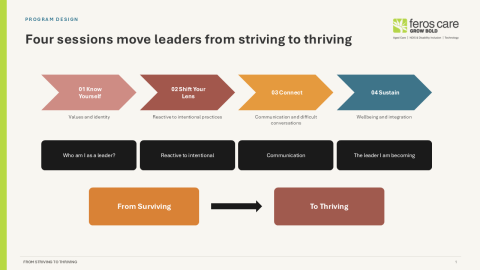
The pilot was evaluated using a mixed-methods approach, incorporating pre and post surveys, observations, interviews, participant reflections, and client feedback.
The strongest evidence of change emerged in relation to leadership identity, boundary setting, communication and reflective practice. Participants reported greater awareness of when they should facilitate rather than solve problems, increased confidence in delegating responsibility, and a growing ability to distinguish between issues they could influence and those beyond their control.
These qualitative insights appeared to be supported by pre-post staff survey data, in which we observed a 25% lift in perceptions of the work environment as empowering, and a 21% lift in perceived self-efficacy. The pre-post survey samples were small (n=10 and n=8, respectively), but this data is encouraging.
The pilot program also started to shift the culture around leadership:
- First, it created a rare opportunity for leaders to pause and reflect on their leadership practice.
- Second, the program gave participants more insight into their leadership style, values, communication style, and emotional responses to workplace challenges.
- And third, the program made discussions of emotional labour, burnout, and wellbeing more visible and more acceptable within the cohort.
- Therefore, rather than eliminating the emotional demands of leadership, the program appeared to provide leaders with the space, language, tools, and psychological permission to recognise, discuss and manage these challenges more effectively.
Client outcomes also demonstrated positive trends, with overall client satisfaction increasing over the evaluation period. While the intervention was not directly targeted at client outcomes, these findings suggest potential downstream benefits associated with leadership development and workplace culture improvements.
Due to the success of the pilot program, plans are in place to scale it across broader leadership cohorts within the organisation. In fact the program has been so well received it has created demand across all levels of management.
We also believe the From Surviving to Thriving program could have benefits across the sector. As organisations continue to navigate workforce shortages, psychological risks, increasing service complexity, and sector reform, the program offers a scalable and evidence-informed approach to support workforce wellbeing, organisational resilience, and quality care outcomes.
Rather than treating reflection as a standalone activity, the program embedded reflection into discussions, peer learning, workplace application, mentoring conversations, and the use of Mirror Moments. The Mirror Moments encouraged leaders to use their own experiences, reactions, and observations as opportunities to better understand and support others. This approach created a bridge between self-awareness and leadership action, fostering empathy and more intentional leadership behaviours.
The program also drew on reflective practice, recognising that many leadership challenges do not have simple technical solutions. Participants were encouraged to explore assumptions, examine patterns, learn from experience, and develop adaptive responses to complex situations. In doing so, leadership development became an ongoing process rather than a one-off training event.
Sector Resources
Feros Care and ARIIA are pleased to share the following resources with the aged care sector to assist other providers wanting to implement similar solutions.